


Quick answer: A moving carrier owns or operates the trucks and is legally responsible for your goods. A moving broker sells the move and hands it to a carrier. Brokers are legal, but federal rules require them to say they are brokers, name the carriers they use, and base any estimate on that carrier’s survey and tariff.
Both need registration with the Federal Motor Carrier Safety Administration, and both get a USDOT number and an MC number. The difference shows up when something goes wrong: the carrier that takes your goods is the company your claim, your delivery date and your 110% protection depend on. The broker rules are in 49 CFR Part 371, and the carrier rules in 49 CFR Part 375.
Last updated: October 23, 2026
What is the difference between a moving broker and a moving carrier?
A household goods motor carrier transports your belongings and issues the bill of lading, the contract for the move. A household goods broker, as defined in 49 CFR 371.103, is a company other than a carrier or its agent that sells, negotiates or arranges interstate moves for compensation. A van line agent is not a broker when it books moves for its own van line.
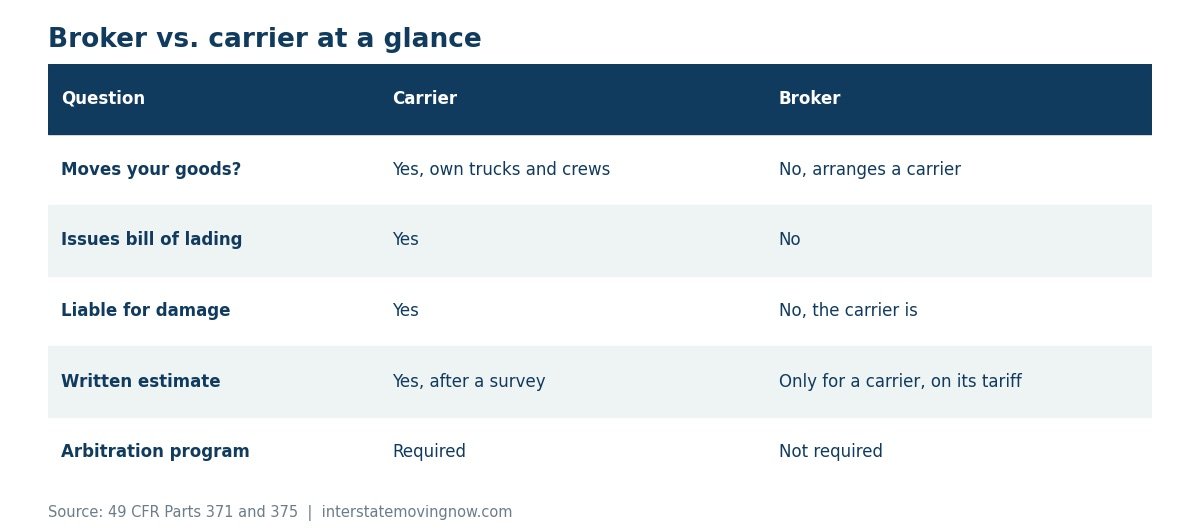
| Question | Carrier | Broker |
|---|---|---|
| Moves your goods? | Yes, with its own trucks and crews | No, arranges a carrier |
| FMCSA registration | USDOT number + carrier operating authority (MC) | USDOT number + broker authority (MC) |
| Issues the bill of lading | Yes | No |
| Liable for loss and damage | Yes, under 49 CFR 375.201 | No, the carrier is |
| Can give a written estimate | Yes, after a physical or video survey | Only on the carrier’s behalf, with a signed agreement, on the carrier’s tariff |
| Must have an arbitration program | Yes, under 49 CFR 375.211 | No |
What must a moving broker tell you by law?
Under 49 CFR 371.107, a broker’s ads and website must prominently show its physical address, its USDOT and MC numbers, and a statement that it is a household goods broker that will not transport your goods but will arrange an FMCSA-authorized carrier whose charges follow that carrier’s tariff. It may only show the names or logos of carriers it has a written agreement with.
When you contact a broker, 49 CFR 371.109 requires it to give you a list of every carrier it uses, with their USDOT and MC numbers, and a statement that it is not a carrier. Section 371.117 adds that its cancellation, deposit and refund policies must be disclosed on its website and in its agreement with you.
Can a broker give you a binding estimate?
Only on a carrier’s behalf. 49 CFR 371.113 says a broker’s estimate must be written, based on a physical survey conducted by the carrier that will move you (on-site or by video), and built on that carrier’s published tariff. Under 49 CFR 375.409, the carrier must have a signed agreement adopting the broker’s estimate as its own, which also binds the carrier to the 110% rule at delivery.
In practice this is where moves go wrong. A broker quotes a low price from a phone inventory, sells the job to whichever carrier accepts it, and the carrier re-prices on moving day because it never surveyed the home. If your estimate came from a broker, ask for the carrier’s name, the signed agreement and the carrier’s survey before you pay a deposit. Our guide to binding vs. non-binding estimates explains what each type protects.
How can you tell if you are talking to a broker?
Look up the USDOT number in FMCSA’s SAFER Company Snapshot. The record shows whether the company is authorized as a carrier, a broker or both, and lists its trucks and drivers. A company with zero power units and broker authority only is a broker, whatever its website says.
- Ask directly: “Will your own trucks and crews move my goods?” A legal broker must say no.
- Find the USDOT and MC numbers on the website. If they are missing, that alone breaks 49 CFR 371.107.
- Check the numbers in SAFER: operating status, authority type, power units.
- Ask which carrier will move you, and look that carrier up too, including its complaint record. Our FMCSA complaints report summarizes what movers are most often reported for.
- Get the carrier’s bill of lading terms before pickup day, not on it.
Is it better to book with a broker or a carrier?
Booking directly with a carrier gives you one company that surveys, prices, moves and answers claims. That is the simpler path for most interstate household moves. A broker can make sense when it is transparent: it names the carrier up front, the carrier does the survey, and the estimate is binding or binding not-to-exceed. Our rule: if a company cannot tell you who will drive the truck before you pay a deposit, don’t pay the deposit.
Price differences are real but often smaller than they look. Compare the quotes on the same basis using our moving company pricing report and the interstate moving cost calculator, and remember that a non-binding quote can end up 10% higher at delivery.
Who is responsible if a broker’s carrier damages your goods?
The carrier. Liability for loss and damage sits with the household goods carrier under 49 CFR 375.201, and claims are filed with the carrier that issued the bill of lading, under 49 CFR Part 370. The broker has no claims or arbitration duty for your goods. That is why the carrier’s name, USDOT number and valuation terms need to be on your paperwork before loading.
FAQ
Are moving brokers legal?
Yes. Household goods brokers are legal if they hold FMCSA broker authority, disclose that they are brokers, list the carriers they use and follow the estimate rules in 49 CFR Part 371. What is illegal is a broker presenting itself as a carrier or quoting without the carrier’s survey and agreement.
Do brokers have USDOT numbers?
Yes. A broker has a USDOT number and an MC number for broker authority. The SAFER record shows the authority type, so a USDOT number alone does not prove a company owns trucks.
Can a broker take a deposit?
Federal rules don’t ban it, but a broker must publish its deposit, cancellation and refund policy on its website and in your agreement under 49 CFR 371.117. Read that policy before paying, and prefer a card payment you can dispute.
Who do I call on moving day if I booked through a broker?
The carrier named on your bill of lading. The carrier controls pickup and delivery dates, and it must notify you of delays under 49 CFR 375.605. Get the carrier’s dispatch number before the move.






No Comments