


Quick answer: A long-distance move usually takes 2 to 14 days from pickup to delivery. Moves under 1,000 miles often arrive in 2 to 7 days, and cross-country moves in 5 to 14. Your mover must put the agreed delivery date or delivery window, called the spread, on the bill of lading and deliver within it.
The range is wide because two things set it: how far the truck drives, and whether your shipment rides alone or shares a truck with other households. Federal driving-time limits for truck drivers set a hard floor, and the delivery spread on your bill of lading sets the legal ceiling. The figures below come from Allied Van Lines’ 2026 delivery timeline guide and FMCSA’s rules.
Last updated: October 23, 2026
How long does a long-distance move take by distance?
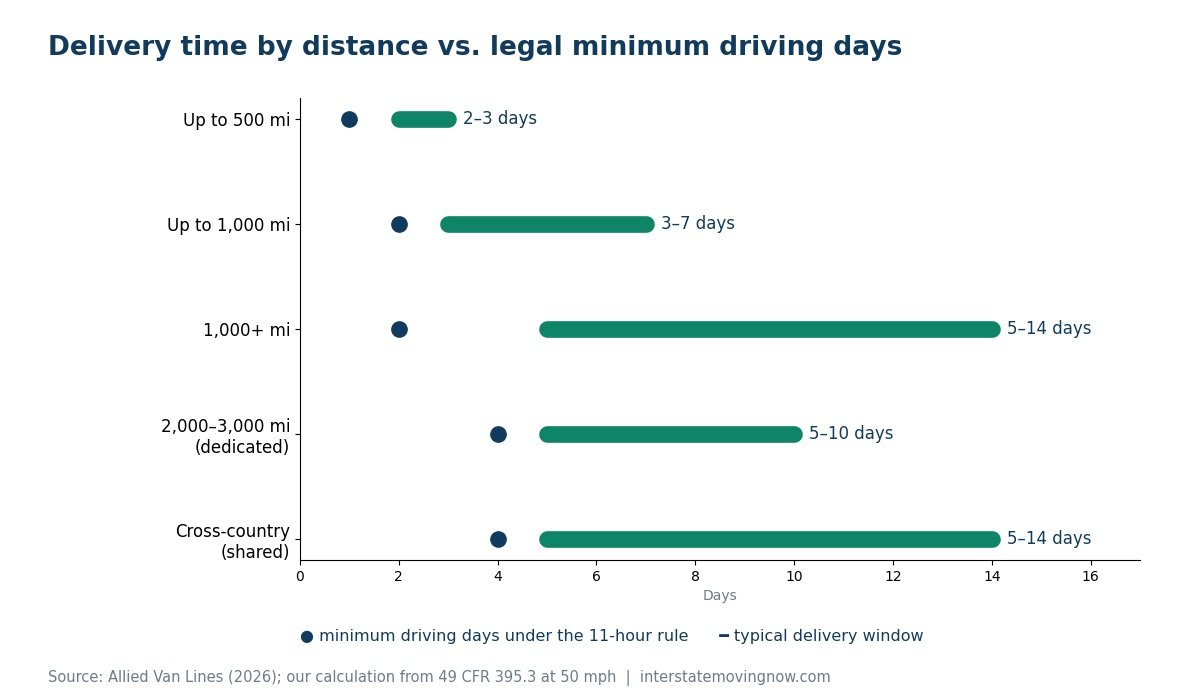
Allied Van Lines puts the average long-distance shipment at 2 to 14 days, and breaks it down by distance:
| Distance | Typical delivery time (Allied) | Minimum driving days (our calculation) |
|---|---|---|
| Up to 500 miles | 2 to 3 days | 1 |
| Up to 1,000 miles | 3 to 7 days | 2 |
| 1,000+ miles | 5 to 14 days | 2 to 6 |
| 2,000 to 3,000 miles, dedicated truck | About 5 to 10 days | 4 to 6 |
| Cross-country, shared truck | Up to 14 days | 4 to 6, plus stops |
Our analysis: the minimum driving days column applies the federal limit of 11 driving hours per day from 49 CFR 395.3 to an assumed average of 50 mph including traffic and fuel stops, or about 550 miles a day at most. A roughly 3,000-mile Boston-to-Los Angeles run needs five to six full driving days before any loading, unloading, weather or rest beyond the legal minimum. Anyone promising coast-to-coast delivery in two days is either using a team of two drivers or not being straight with you.
Why do driving-hour rules slow down your delivery?
Moving truck drivers follow FMCSA’s hours-of-service rules for property-carrying vehicles. Under 49 CFR 395.3, a driver must start each shift after 10 consecutive hours off duty, may drive no more than 11 hours within a 14-hour on-duty window, and needs a 30-minute break after 8 hours of driving. There is also a weekly cap of 60 on-duty hours in 7 days, or 70 in 8 days, depending on the carrier’s schedule.
The weekly cap matters on the longest routes. A 3,000-mile trip at 50 mph is about 60 hours of driving alone, which reaches the weekly limit before loading and unloading time is counted. The driver then needs a long reset before driving again. That is one reason cross-country spreads often run past a week even on a dedicated truck.
What is a delivery spread, and is it legally binding?
A delivery spread is the window of dates during which the mover agrees to deliver, written on the bill of lading. Under 49 CFR 375.603, the mover must tender your shipment for delivery on the agreed date or within that period, unless you agree to change it. FMCSA calls this “reasonable dispatch,” and 49 CFR 375.601 requires it on every move except those with guaranteed pickup and delivery dates, which follow their own contract terms.
Allied describes a typical cross-country spread as 5 to 14 business days. A guaranteed delivery date is usually available for an extra charge. Ask what the mover pays you per day if it misses a guaranteed date, and get that in writing.
Why does a shared truck take longer?
Smaller shipments, like a one-bedroom apartment, usually travel on a shared truck with other households. The driver picks up and drops off along a route, so your delivery depends on the other stops. Allied says that can stretch a cross-country window to 14 days, while a full household on a dedicated truck goes directly and often takes about 5 to 10 days. If timing matters more than price, ask for a dedicated truck or exclusive use of the vehicle and compare the cost.
Season matters too. Allied reports that up to 70% of relocations happen between May and September, when trucks are full and windows get longer. See how prices and demand move through the year in our seasonal moving cost index and best and worst months to move.
What if your mover is late?
The mover must tell you as soon as it knows it can’t meet the dates on the bill of lading. 49 CFR 375.605 requires notice by phone, in person, email, fax, overnight courier or certified mail, a new expected date, and a written record of the notice that you can request. If the truck arrives more than 24 hours early and you can’t accept it, the mover may put the goods in storage at its own expense and liability until the agreed date, under section 375.607.
A delivery outside the spread is a failure of reasonable dispatch, and you can file a delay claim for costs it caused, such as hotel nights or replacement essentials, under the claims rules in 49 CFR Part 370. Keep receipts. Our guide to filing a claim with an interstate mover walks through deadlines and arbitration.
How to plan around the delivery window
- Ask for the spread in writing at estimate stage, not on pickup day.
- Pack a two-week essentials kit: bedding, kitchen basics, work equipment, documents, medications.
- Book flexible temporary housing or a short stay that covers the full spread.
- Give the driver a phone number that works for the whole window, and ask for a 24-hour heads-up.
- If you can’t take delivery inside the window, arrange storage-in-transit before the move, not after.
FAQ
How long does it take movers to drive across the country?
Driving alone takes at least four to six days for 2,000 to 3,000 miles under federal 11-hour driving limits. Total delivery time, including loading and other stops, typically runs 5 to 14 days.
Can I pay for faster delivery?
Yes. Most movers offer guaranteed delivery dates or exclusive use of a truck for an extra charge. Both shorten or fix the window, so compare their cost with a few nights of temporary housing.
When does the delivery spread start?
The dates written on your bill of lading set it, so there is no standard start point. Ask the mover to write the first and last possible delivery dates, not just a number of days.
What happens if my goods arrive before I do?
The mover can ask you to accept early delivery. If you can’t, and the truck is more than 24 hours early, it may store the goods at its own expense until the agreed date under 49 CFR 375.607.







No Comments