


Quick answer: A binding estimate fixes the price of an interstate move for the items and services listed. A non-binding estimate is an approximation: the final bill follows the actual weight, but federal rules cap what you pay at delivery at 110% of the estimate. A binding not-to-exceed estimate caps the price and lowers it if your shipment weighs less.
The rules come from the Federal Motor Carrier Safety Administration’s household goods regulations, 49 CFR 375.401 to 375.409. Every interstate mover must give you a written, signed estimate before loading, and it must say on its face whether it is binding or non-binding. A verbal quote over the phone is not an estimate under these rules.
Last updated: October 23, 2026
What is a binding moving estimate?
A binding estimate is a written agreement that guarantees the total cost of the move for the quantities and services shown on it. Under 49 CFR 375.403, the mover must base it on a physical survey of your belongings (in person or by live or recorded video), put it in writing, and state clearly that both sides are bound by the charges.
Two details matter in practice. First, a mover may charge a fee for preparing a binding estimate, while a non-binding estimate must be free. Second, the guarantee only covers what is listed. If you add a garage full of boxes on moving day, the mover can refuse to honor the estimate. Before loading, it must either reaffirm the price, write a new binding estimate that you sign, or agree with you in writing to treat the original as non-binding. Once the truck is loaded without one of those steps, the original binding price stands.
What is a non-binding estimate, and what is the 110% rule?
A non-binding estimate is the mover’s reasonably accurate forecast of the cost, based on estimated weight or volume and the services you requested. The final charge is calculated from the actual weight of your shipment and the mover’s tariff, so it can be higher than the estimate.
The protection is the 110% rule in 49 CFR 375.405. At delivery, the mover cannot demand more than 110% of the non-binding estimate, plus charges for extra services you asked for after the bill of lading was issued and, where they apply, impracticable-operation charges capped at 15% of the other charges due. If you pay that amount, the mover must release your goods. Holding them for more counts as failing to deliver with “reasonable dispatch” under 49 CFR 375.407.
The 110% cap applies to what you pay on delivery day, not to the total. Any remaining balance is invoiced later: under 49 CFR 375.807, the mover must send the invoice within 15 business days of delivery.
What does a binding not-to-exceed estimate add?
A binding not-to-exceed estimate, also called guaranteed not to exceed, works like a binding estimate with one difference: if the shipment weighs less than estimated, the price goes down to match the actual weight. If it weighs more, you still pay the binding price. It is a commercial product that many movers offer under their tariffs, not a separate category in the federal rules, so read how the mover defines it.
moveBuddha and HireAHelper both describe it as the most consumer-friendly option, because the risk of a heavy shipment sits with the mover. The usual catch: the guarantee is tied to the inventory on the estimate, so items you add later can void it.
Binding vs. non-binding vs. not-to-exceed: side by side
| Feature | Binding | Non-binding | Binding not-to-exceed |
|---|---|---|---|
| Final price | Fixed for listed items and services | Actual weight × tariff | Lower of the estimate or the actual-weight price |
| Max due at delivery | 100% of estimate + extras you added | 110% of estimate + extras you added | Estimate or less + extras you added |
| Fee for the estimate | Allowed | Not allowed | Depends on the mover’s tariff |
| Shipment weighed? | Not needed for the price | Yes, on a certified scale | Yes, if you want the lower price |
| Who carries the weight risk | Mover (above), you (below) | You | Mover |
| Best for | Known inventory, no late additions | Rarely the best choice | Most interstate household moves |
How does the 110% rule work on a real bill?
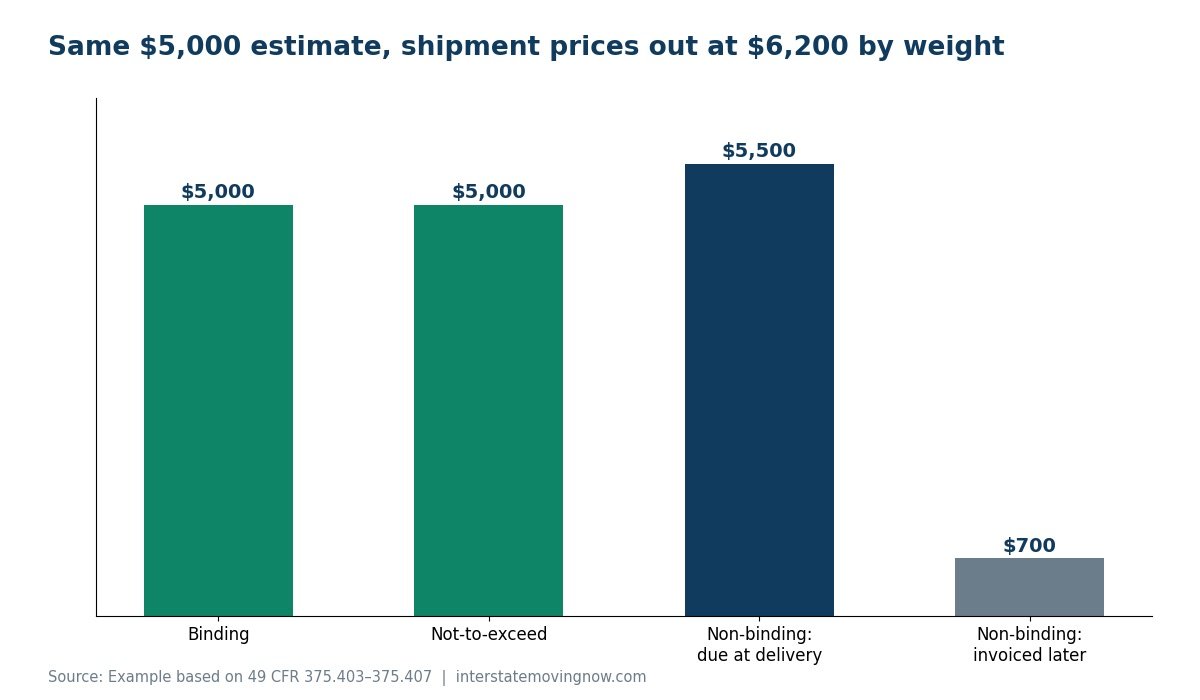
Take a non-binding estimate of $5,000 for a two-bedroom move. The truck is weighed and the tariff price for the actual weight comes to $6,200. At delivery, the most the mover can demand is $5,500 (110% of $5,000), plus anything you added after the bill of lading. You pay $5,500 and your goods come off the truck. The other $700 arrives as an invoice within 15 business days, with a credit period of at least seven days.
With a binding estimate of $5,000 for the same inventory, you pay $5,000 whatever the scale says. With a binding not-to-exceed estimate of $5,000, a shipment that prices out at $4,600 costs $4,600, and one that prices out at $6,200 still costs $5,000.
Which estimate should you choose?
Our rule of thumb for interstate moves: ask every mover for a binding not-to-exceed estimate first, then a binding estimate. Accept a non-binding estimate only when the mover won’t offer either, and then compare movers on 110% of their number, not on the number itself. A low non-binding estimate is the most common way a quote looks cheaper than it is. If one estimate is far below the others, check the mover’s record in our FMCSA complaints report before you book.
- Get at least three written estimates based on a survey (video counts), not on a phone call.
- Check that each one says binding or non-binding on its face and lists every service: packing, stairs, long carry, shuttle, storage.
- Confirm the inventory matches what you are actually taking, including the garage, attic and storage unit.
- Do not add items on moving day without a new signed estimate.
- Keep your signed, dated copy. The mover must keep its copy for at least a year.
To see what a fair price looks like for your route before the surveys, run your numbers through our interstate moving cost calculator and compare them with typical moving company pricing.
What red flags should you watch for in an estimate?
An estimate given only by phone or email with no survey, a large cash deposit, or a document that doesn’t state binding or non-binding all fall short of what the federal rules require. So does a mover that asks you to sign a blank or incomplete bill of lading. FMCSA’s consumer booklet, Your Rights and Responsibilities When You Move, must be given to you before the move, and it repeats the 110% rule in plain language. Our list of questions to ask a moving company covers the rest of the vetting.
FAQ
Is a binding moving estimate legally enforceable?
Yes. Under 49 CFR 375.403, a binding estimate becomes part of the bill of lading contract, and the mover may not collect more than the binding amount once the shipment is loaded, except for services you add later and capped impracticable-operation charges.
Can a mover charge more than a non-binding estimate?
Yes, but not all at once. On delivery, the mover can demand at most 110% of the non-binding estimate plus extras you requested. Any remaining charges based on actual weight must be invoiced after delivery, within 15 business days.
Do I have to pay for a moving estimate?
A non-binding estimate must be free under federal rules. A mover may charge for a binding estimate if its tariff allows it, so ask before the survey.
Can a mover change the estimate on moving day?
Only before loading and only with your agreement. If you add items or services, the mover can write a new estimate for you to sign. After loading, the estimate can’t be amended, and the original price applies.
Is a virtual survey enough for a binding estimate?
Yes. Since 2022, FMCSA defines a physical survey as one done on-site or virtually, through live or pre-recorded video that lets the mover clearly see the goods. You can also waive the survey in writing, though that weakens your position if the inventory is disputed.






No Comments