


Quick answer: For most people, moving expenses are not tax deductible in 2026. The One Big Beautiful Bill Act, signed July 4, 2025, made the federal suspension permanent. Only active-duty military moving under permanent change-of-station orders and, from 2026, intelligence community employees relocating on assignment can still deduct them. Some states, including California, still allow a state deduction.
The deduction lives in Section 217 of the Internal Revenue Code. The 2017 Tax Cuts and Jobs Act suspended it for tax years 2018 through 2025. Instead of letting it return in 2026, Public Law 119-21, section 70113 rewrote the suspension so it applies to every tax year after 2017 with no end date, and added a new exception. The same change applies to tax-free employer reimbursements under Section 132(g).
Last updated: October 23, 2026
Who can still deduct moving expenses in 2026?
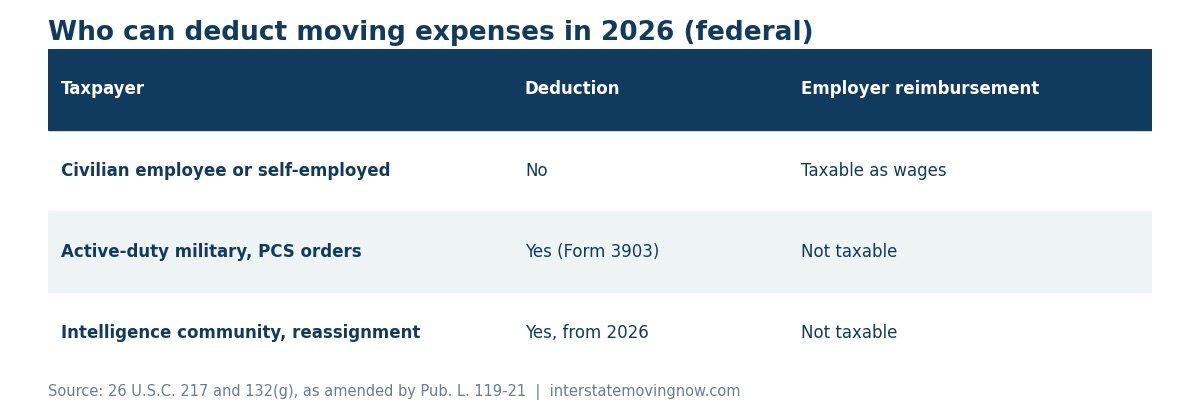
Two groups, under 26 U.S.C. 217(g) and (k):
| Taxpayer | Federal deduction | Employer reimbursement taxable? | Since |
|---|---|---|---|
| Civilian employee or self-employed | No | Yes, as wages | Tax year 2018, now permanent |
| Active-duty Armed Forces, permanent change of station | Yes (Form 3903) | No | Never suspended |
| Intelligence community employee or new appointee relocating on a change in assignment | Yes, same as military | No | Tax years beginning after Dec. 31, 2025 |
The intelligence community is defined by section 3 of the National Security Act of 1947 and covers agencies such as the CIA, NSA and the intelligence elements of other departments. Members of the Armed Forces fall under the military rule instead. Military filers use IRS Form 3903, and IRS Publication 3 explains which moves qualify.
Is a relocation package from my employer taxable?
Yes, for civilians. Because Section 132(g)(2) suspends the exclusion for qualified moving expense reimbursements, money your employer pays you or pays the mover on your behalf counts as taxable wages, subject to income and payroll taxes. Many employers “gross up” the package, adding extra pay to cover the tax. Ask whether yours does before you accept an offer, because a $10,000 package without a gross-up can be worth a few thousand dollars less after tax. Our guide on negotiating a relocation package covers what to ask for.
Which states still allow a moving expense deduction?
States decide for themselves whether to follow federal changes. California is one that did not: its Form FTB 3913 for tax year 2025 lets non-military taxpayers who pass the distance and time tests deduct transportation and storage of household goods and travel to the new home (lodging included, meals excluded), net of amounts the employer paid that weren’t included in W-2 wages.
Other states also keep their own rules, and they change. Before you file, check your state revenue department’s current instructions for the year of your move, for both the state you left and the state you moved to if you file part-year returns in each. Our guide to taxes after an out-of-state move covers residency and part-year returns.
What are the distance and time tests?
They come from Section 217(c), and states that still allow the deduction, like California, generally use them. Military members on permanent change-of-station orders are exempt from both.
- Distance test: your new main job location is at least 50 miles farther from your old home than your old job was. If you had no previous job, the new one must be at least 50 miles from your old home.
- Time test (employees): you work full time in the new area for at least 39 weeks in the 12 months after you arrive.
- Time test (self-employed): you work full time in the new area for at least 78 weeks in the 24 months after arrival, including at least 39 weeks in the first 12 months.
What moving costs count as deductible, where allowed?
Section 217 allows two categories: moving household goods and personal effects (packing, transport, storage in transit, up to 30 days of storage after removal from the old home under the federal definition), and travel from the old home to the new one, including lodging but not meals. House-hunting trips, temporary living costs after arrival, and costs of selling or buying a home do not qualify.
Our take: since most interstate movers can no longer deduct anything federally, the real tax lever is the relocation package and the timing of state residency, not receipts. Keep your moving invoices anyway: they matter if you’re military, if your state allows the deduction, or if your employer reimburses against receipts. To estimate the cost you’ll be budgeting without a deduction, see our interstate moving cost calculator.
FAQ
Will the moving expense deduction come back after 2025?
No. The original suspension was set to end after 2025, but the One Big Beautiful Bill Act made it permanent for non-military taxpayers, with a new exception for intelligence community employees starting in 2026.
Can I deduct moving expenses if I’m self-employed?
Not on your federal return. The suspension covers self-employed taxpayers too. Business relocation costs of the business itself are a separate question for your tax preparer.
Do military members still use Form 3903?
Yes. Active-duty members moving under permanent change-of-station orders deduct unreimbursed moving expenses on IRS Form 3903, and in-kind moves or allowances from the government are not taxable.
Are moving expenses deductible on my California return?
For tax year 2025, yes, if you meet the distance and time tests, using Form FTB 3913. Check the Franchise Tax Board’s instructions for the tax year of your move.








No Comments