


Quick answer: To file a damage claim against an interstate mover, send the carrier a written claim that identifies the shipment, says it is liable for the loss or damage, and asks for a specific dollar amount. Federal law gives you at least 9 months from delivery to file. The mover must acknowledge it within 30 days and pay, decline or offer a settlement within 120 days.
These deadlines come from federal law, not from the mover’s goodwill. The 9-month minimum is set by the Carmack Amendment, 49 U.S.C. 14706(e). The 30-day and 120-day rules are in FMCSA’s claims regulation, 49 CFR Part 370. What you can recover depends on the valuation you chose on the bill of lading.
Last updated: October 23, 2026
How long do you have to file a claim against an interstate mover?
At least 9 months from delivery. Under 49 U.S.C. 14706(e), a carrier may not give you less than 9 months to file a claim, or less than 2 years to sue after it notifies you in writing that it is denying all or part of the claim. Check your bill of lading: it may give you more time, never less. If your goods sat in storage-in-transit, 49 CFR 375.609 also gives you a 9-month window after the storage converts to permanent storage.
Don’t wait for the deadline. Damage noted on delivery day and claimed within weeks is far easier to prove than a crack you report in month eight.
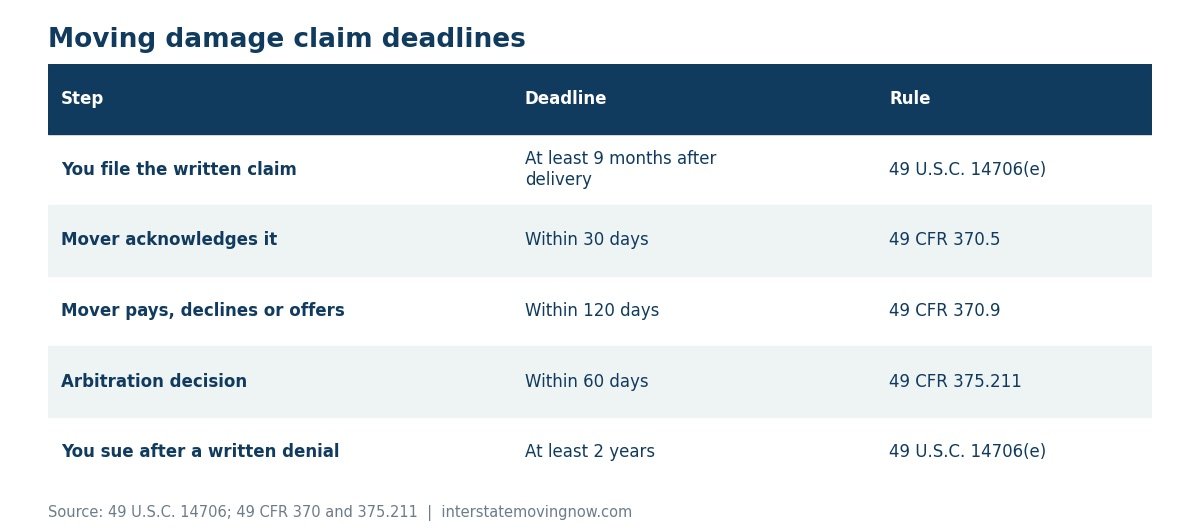
| Step | Deadline | Rule |
|---|---|---|
| You file the written claim | At least 9 months after delivery | 49 U.S.C. 14706(e) |
| Mover acknowledges receipt | Within 30 days | 49 CFR 370.5 |
| Mover pays, declines or offers a settlement | Within 120 days | 49 CFR 370.9 |
| Arbitration decision (if you choose it) | Within 60 days of the arbitrator’s notice | 49 CFR 375.211 |
| You sue after a written denial | At least 2 years | 49 U.S.C. 14706(e) |
What has to be in a moving damage claim?
A claim counts once it meets three minimum requirements in 49 CFR 370.3: it is in writing, it contains facts that identify the shipment, and it asserts the carrier’s liability while asking for a specific or determinable amount of money. Notes on the delivery receipt, inspection reports or a phone call do not count as a claim on their own.
A claim that gets paid quickly usually includes:
- Bill of lading number, pickup and delivery dates, origin and destination.
- An itemized list: each item, its inventory number from the mover’s tag, what happened (lost, broken, scratched), and the amount you claim.
- Photos of the damage and, if you have them, photos from before the move.
- Receipts, repair estimates or replacement prices for each item.
- A copy of the delivery receipt or inventory where you noted the damage.
Send it in a way you can prove: the mover’s claim portal with a confirmation, email, or certified mail. Keep a copy of everything.
How much will the mover pay? It depends on valuation
Interstate movers offer two liability levels, described in 49 CFR 375.201. Full Value Protection makes the mover liable for the replacement value of lost or damaged items, up to the declared value of the shipment: it may repair, replace or pay you. Released value is the minimum coverage you get only if you waive full value in writing, and it pays by weight, at the rate in the Surface Transportation Board’s released rates order (60 cents per pound per article is the figure the regulation uses as the threshold).
The gap is large. Under released value, a 40-pound television that breaks is worth about $24 to the mover, however much you paid for it. When settling a claim, 49 CFR 370.9 requires the mover to start from replacement cost and apply depreciation to reach the item’s current actual value. One more trap: on Full Value Protection, the mover can limit its liability to $100 per pound for any article worth more than that unless you listed it in writing, under 49 CFR 375.203. List jewelry, art and collectibles before loading. Our moving insurance and valuation report compares what each option costs.
What happens if the mover denies or lowballs your claim?
Every interstate household goods carrier must run an arbitration program under 49 CFR 375.211. If you request it, arbitration is binding for claims of $10,000 or less; above $10,000, it is binding only if the mover also agrees. The mover can’t charge you more than half the cost of starting the case, can’t force you to agree to arbitration before a dispute exists, and the arbitrator must decide within 60 days of receiving the written dispute.
Your other option is court. A written denial starts the 2-year clock for a lawsuit under the Carmack Amendment. For most household claims under $10,000, arbitration is faster and cheaper than suing. Before either, reply to a lowball offer in writing with your evidence: an offer of compromise does not count as a denial unless the mover says in writing that part of the claim is disallowed and why.
Can the mover hold your goods or charge you until the claim is settled?
No. A pending claim does not let the mover keep your belongings, and you don’t have to withhold payment to keep your claim alive. Pay what is due at delivery (on a non-binding estimate, no more than 110% of the estimate) and file the claim separately. If part of the shipment is lost or destroyed in transit, 49 CFR 375.707 limits what the mover can collect for that part, and a totally lost shipment carries no freight charges at all. Late delivery is also claimable: our guide on what to do if your mover is late or loses your things covers delay claims.
A delivery-day checklist that protects your claim
- Check every item against the mover’s inventory as it comes off the truck.
- Write damage and missing items on the inventory and the delivery receipt before you sign. “Subject to inspection” is weaker than a specific note.
- Photograph damaged items and the boxes they came in, then keep the packaging.
- Don’t throw away or repair anything before the mover has had a chance to inspect it.
- File the written claim within days, not months, even if the full amount is not yet known: the claim can name a determinable amount and you can add repair estimates.
FAQ
Is the 9-month deadline from pickup or delivery?
Bills of lading usually count from delivery, or from the date delivery should have happened if the shipment is lost. Federal law sets 9 months as the minimum, so a bill of lading can allow more time but never less.
Can I file a claim if I signed the delivery receipt without noting damage?
Yes. Signing doesn’t waive your claim; you have at least 9 months to file. Unnoted damage is harder to prove, so document it with photos and file as soon as you find it.
Does FMCSA resolve moving damage claims?
No. FMCSA regulates movers and records complaints, but it does not decide claims or order payment. Claims go to the carrier, then to the carrier’s arbitration program or to court.
How much does arbitration cost?
It depends on the mover’s program, but federal rules cap your share of the cost to start the case at half, and the arbitrator can decide who pays. The mover must give you a summary of the program and its costs before the move.








No Comments