


Quick answer: You can move most indoor houseplants across state lines, but some states inspect them at the border and can reject or destroy plants with pests or soil from outdoors. California is the strictest: it bans citrus plants and inspects plants at 16 border stations. Outdoor items leaving a federal spongy moth quarantine area must be inspected before the move.
There is no single national rule for houseplants. Federal quarantines cover specific pests and plants, and each state’s agriculture department sets its own entry rules on top of them. The rules below come from the California Department of Food and Agriculture and the USDA Animal and Plant Health Inspection Service.
Last updated: October 23, 2026
Which states inspect plants when you move in?
States with large farm economies run agricultural checkpoints on highways that enter them. California’s Department of Food and Agriculture operates sixteen border protection stations on major roads from Oregon, Nevada and Arizona. Florida’s Office of Agricultural Law Enforcement runs agricultural inspection stations on highways entering the state, focused on pests and unpermitted plants and animals. Other states have rules but no staffed border stops, so the rules still apply even when nobody checks.
Before you pack, check the destination state’s department of agriculture (often listed as the State Plant Regulatory Official) for its entry rules. Your current state’s agriculture department can also tell you which federal quarantines cover your area.
What houseplants can you bring into California?
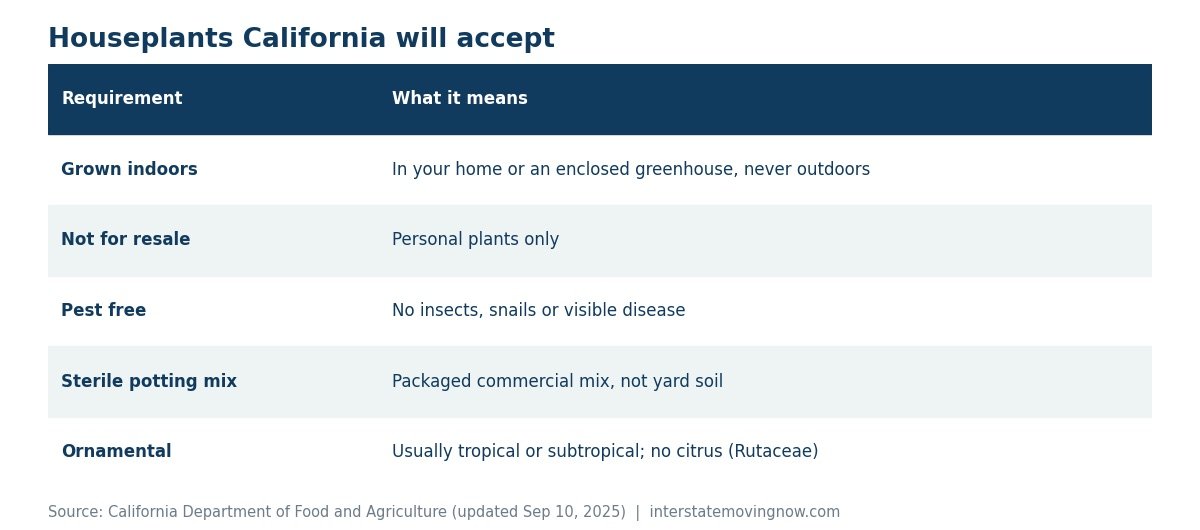
California’s border inspectors accept plants that meet all five conditions in CDFA’s house plant guidance (updated September 10, 2025):
- Grown in your home, indoors only, or in an enclosed greenhouse. Plants kept outside, even for a summer, don’t qualify.
- Not for resale.
- Free of pests, with no visible disease.
- Potted in sterile, packaged commercial potting mix, not soil from a yard.
- An ornamental plant, usually a tropical or subtropical one.
All citrus plants and other members of the Rutaceae family are prohibited. CDFA strongly discourages bringing pine, oak, fruit and nut trees unless every federal and state quarantine is satisfied. Plants from areas regulated for burrowing, reniform or guava root-knot nematodes are not exempt. Inspectors may reject and destroy any plant that shows insects, snails or disease.
How do you declare plants on a moving truck?
It depends on who is driving. For a professional mover, CDFA says the mover must write “house plants” at the top of the shipment inventory and load the plants near the van doors so inspectors can reach them. If you drive your own car or rental truck, you must declare plants to the border inspector and keep them easy to reach. Fresh fruit and vegetables are subject to inspection too, so eat or give away the produce before the drive.
Ask your mover early whether it will carry plants at all. Some movers’ tariffs exclude live plants, especially on long hauls, because plants can die in a closed trailer and carry pests across state lines. If the mover won’t take them, carry them in your car or ship cuttings instead.
What is the spongy moth inspection, and does it apply to you?
The spongy moth, formerly called the gypsy moth, is a federal quarantine pest that feeds on over 300 kinds of trees and shrubs. According to USDA APHIS, if you move from a quarantine area to a non-quarantine area, you must inspect your outdoor household items and remove all life stages of the insect before moving, and you may face penalties if you don’t. If you don’t live in a quarantine area, the rule doesn’t apply. APHIS points movers to an address lookup map at YourMoveSpongyMothFree.com to check whether a home is inside the quarantine area.
| Step | What APHIS requires |
|---|---|
| Who inspects | You, using the self-inspection checklist, or a qualified certified applicator |
| What to inspect | Outdoor household articles: patio furniture, lawn equipment, toys, grills, trailers, vehicles |
| What to do with egg masses | Scrape off and destroy in hot, soapy water or a sealed bag left in the sun |
| Timing, April to August | Inspect on moving day if possible; otherwise keep items sealed, indoors or in a closed truck |
| Paperwork | Keep the signed checklist in the vehicle carrying the goods; give a copy to the driver |
The completed checklist counts as an official certificate accepted by all non-infested states. APHIS recommends keeping a copy for five years.
How do you keep houseplants alive on a long-distance move?
Plants handle a two- or three-day car trip far better than a week or more in a dark trailer, which is what a cross-country delivery window can mean. Our guide to how long a long-distance move takes explains those windows. Practical steps:
- Two to three weeks before: repot anything in garden soil into sterile commercial potting mix, and check leaves and soil for pests.
- A few days before: water lightly, then let the soil dry a little so pots are lighter and less likely to rot.
- Moving day: wrap tall plants in paper or sheets, set pots in open boxes with padding, and keep them out of a trunk on hot or freezing days.
- On arrival: unpack plants first and give them light and water before you unpack anything else.
Plants are one of many items that need special handling; our first-time interstate movers guide covers the rest of the planning, and the moving cost calculator helps you price the move itself.
FAQ
Can I bring a lemon tree to California?
No. California prohibits all citrus plants and plant parts from other members of the Rutaceae family, regardless of where they were grown. Buy a new tree from a California nursery after you arrive.
Will movers move my plants?
Some will and some won’t, especially on long-distance moves. If yours does and you’re moving to California, the inventory must say “house plants” at the top and the plants must be loaded near the doors for inspection.
Do I need a certificate to move houseplants?
For ordinary indoor plants, usually not, but they can still be inspected. Certificates come into play when a federal or state quarantine applies, such as the spongy moth checklist for outdoor items or nursery stock rules. Ask the destination state’s agriculture department.
What happens if border inspectors find a pest on my plant?
In California, inspectors can reject and destroy any plant believed to carry pests or disease. You won’t get it back, so inspect and clean plants before you leave.







No Comments