


Quick answer: Any item worth more than $100 per pound, such as jewelry, silverware, a laptop or a small painting, is a “high-value article” in an interstate move. If you don’t list it in writing before loading, your mover can cap its liability for that item at $100 per pound, even with full value protection. Divide the item’s value by its weight; anything over $100 goes on the high-value inventory.
Most damage claims are paid on weight and value, and small, expensive items lose out under a per-pound cap. The rule is in federal regulation 49 CFR 375.203 and is explained in the consumer booklet movers must give you, “Your Rights and Responsibilities When You Move,” reproduced in Appendix A to Part 375.
Last updated: November 20, 2026
What counts as a high-value item when moving?
An item is high-value, or “of extraordinary value,” when it is worth more than $100 per pound. The federal booklet in Appendix A to 49 CFR Part 375 gives jewelry, silverware, china, furs, antiques, oriental rugs and computer software as examples. The test is value divided by weight, so price alone doesn’t decide it: a $1,500 sofa weighing 150 pounds is $10 per pound, while a $1,500 watch is thousands of dollars per pound.
Electronics often cross the line. A laptop, camera, tablet or game console usually weighs a few pounds and is worth far more than $100 per pound of that weight. So do collections of coins, stamps or watches, and fine art in small formats.
What happens if you don’t declare a high-value item?
If you chose a protection level above the basic 60 cents per pound and did not list an article worth more than $100 per pound in writing, the mover may limit its liability for that article to $100 per pound, under 49 CFR 375.203(b). If you did list it, you are entitled to full recovery up to the declared value of the article, not exceeding the declared value of the whole shipment, under section 375.203(c).
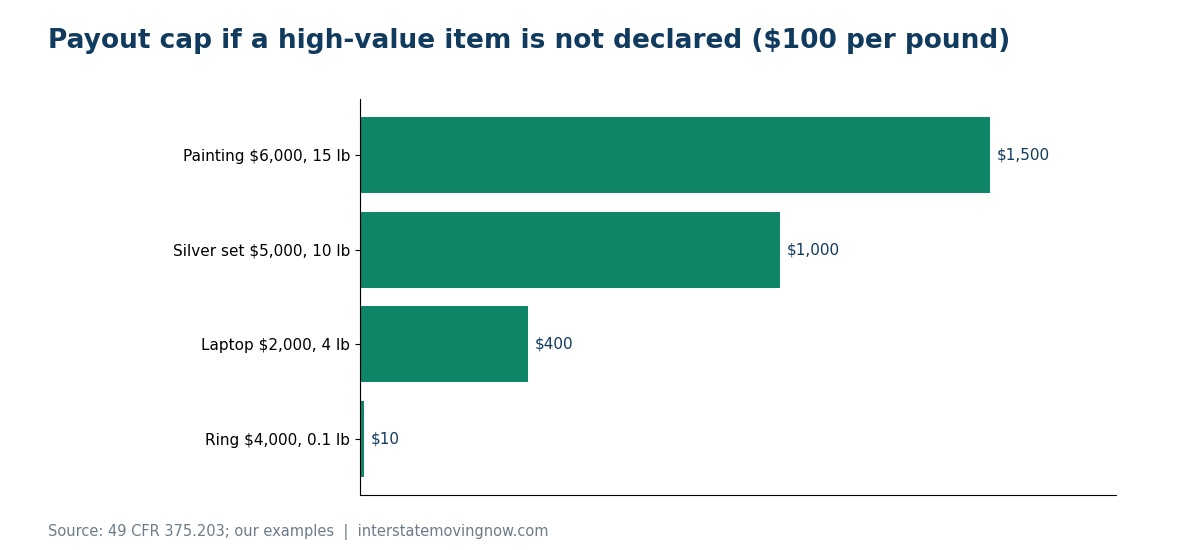
Here is what the cap means in practice, using our own examples:
| Item | Value | Weight | Value per pound | Payout cap if not declared |
|---|---|---|---|---|
| Engagement ring | $4,000 | 0.1 lb | $40,000 | $10 |
| Laptop | $2,000 | 4 lb | $500 | $400 |
| Sterling silver flatware set | $5,000 | 10 lb | $500 | $1,000 |
| Framed painting | $6,000 | 15 lb | $400 | $1,500 |
| Wool area rug | $2,500 | 40 lb | $62.50 | Not high-value |
The cap is weight × $100. Without a declaration, the ring in this example is covered for about $10 and the painting for $1,500 of its $6,000 value.
Does full value protection cover high-value items?
Full value protection covers high-value items only if you list them. Under full value protection the mover is liable for the replacement value of lost or damaged goods, up to the declared value of the shipment, according to 49 CFR 375.201(b). Appendix A sets the minimum declared value for pricing this protection at $6.00 per pound times the shipment’s weight, and says movers may limit liability for articles of extraordinary value unless you specifically list them on the shipping documents.
If you waive full value protection and take released value, coverage is 60 cents per pound per article, according to Appendix A, and the high-value list does not raise it. Our moving insurance and valuation report compares the two options and their costs.
How do you declare high-value items to a mover?
Declare them in writing before loading, usually on a separate high-value inventory form the mover provides. The steps:
| Step | What to do |
|---|---|
| 1. Find the items | Walk each room and divide value by weight for anything small and expensive |
| 2. Document value | Receipts, appraisals or recent listings for comparable items; photos and serial numbers |
| 3. Ask for the form | Request the mover’s high-value or extraordinary-value inventory before moving day |
| 4. List each article | Description, value and condition; keep sets (silverware, collections) itemized |
| 5. Raise the declared value | Make sure the shipment’s declared value covers these items on top of everything else |
| 6. Get a signed copy | The list should be signed with the inventory and bill of lading |
The general inventory must tag every carton and uncartoned item and you must get a signed copy at loading, under 49 CFR 375.503. Our bill of lading guide explains how the documents fit together.
Should you move valuables yourself instead?
For the smallest, most valuable items, carrying them yourself is usually the better choice. Jewelry, cash, coins, important documents and irreplaceable photos are on the “keep with you” lists of major van lines, as our guide to items movers will not move shows. A declaration gets you paid after a loss; it does not replace a family heirloom.
Decision rule: declare, carry or ignore?
- Carry it: under 2 pounds and worth more than $500, or irreplaceable (jewelry, cash, coins, documents, hard drives with family photos).
- Declare it: over $100 per pound and too large or fragile to carry (art, silver sets, china, electronics, antiques).
- Ignore it: under $100 per pound; regular full value protection covers it.
FAQ
What is the $100 per pound rule in moving?
It is the federal threshold for high-value articles. If an item worth more than $100 per pound is not listed in writing, the mover may cap its liability for that item at $100 per pound under 49 CFR 375.203(b), even if you bought protection above 60 cents per pound.
Does homeowners or renters insurance cover items in a moving truck?
Some policies cover belongings in transit and some don’t, and limits for jewelry and similar items are often low. Call your insurer before the move and ask in writing; then decide whether to declare, insure separately or carry the item.
Do I need appraisals for the high-value list?
Federal rules don’t require appraisals, but you will need proof of value if you file a claim. Receipts, appraisals and dated photos make a claim much easier to settle.
Is a TV a high-value item?
Usually not. A large TV weighs enough that its value per pound tends to fall below $100. Check by dividing its value by its weight; small electronics such as laptops and cameras are more likely to exceed the threshold.
Something damaged or missing after delivery? Follow our guide to filing a moving damage claim.






No Comments