


Quick answer: If you move from a spongy moth (formerly gypsy moth) quarantine area, such as New York, New Jersey, Pennsylvania, Massachusetts or Michigan, to a state outside it, federal law requires you to inspect outdoor household items for egg masses and other life stages and remove them before the move. Complete the USDA self-inspection checklist (PPQ Form 377) and keep it in the moving vehicle.
The spongy moth is an invasive insect whose caterpillars strip the leaves from hundreds of tree and shrub species. Females lay egg masses on patio furniture, grills, toys and vehicles, which is how the pest hitches a ride to new states. The rules below come from the federal quarantine regulation 7 CFR 301.45-4, the USDA APHIS spongy moth page and the USDA moving flyer distributed by the North Carolina Department of Agriculture.
Last updated: November 20, 2026
Do I need a spongy moth inspection when moving?
You need one if you are moving from a spongy moth quarantine area to an area that is not quarantined. Under 7 CFR 301.45-4(a)(2), an outdoor household article may not be moved interstate from a quarantined area into or through a non-quarantined area unless it has a certificate or an outdoor household article (OHA) document. For a household move, the completed self-inspection checklist serves as that document, according to the USDA flyer.
If you live outside a quarantine area, the rule does not apply to you. Moving between two quarantined areas, for example New York to New Jersey, also does not require it. Indoor furniture and boxes are not covered; the rule targets items that sit outdoors.
Which states are in the spongy moth quarantine?
Thirteen states and the District of Columbia are quarantined in full, and eight more in part, according to the APHIS list of generally infested areas (last updated August 8, 2023, in the version published on the APHIS site in 2026). Boundaries change, so confirm your county on APHIS’s interactive map before moving.
| Quarantine status | States |
|---|---|
| Entire state | Connecticut, Delaware, District of Columbia, Maine, Maryland, Massachusetts, Michigan, New Hampshire, New Jersey, New York, Pennsylvania, Rhode Island, Vermont |
| Portions of the state | Illinois (10 counties including Cook and DuPage), Indiana (northern counties including Lake and Allen), Minnesota, North Carolina (Currituck County and part of Dare County), Ohio, Virginia, West Virginia, Wisconsin |
Most of the Sun Belt destinations, including Florida, Texas, Georgia, South Carolina, Tennessee, Arizona and California, are outside the quarantine, so the inspection applies to most moves from the Northeast to the South and West.
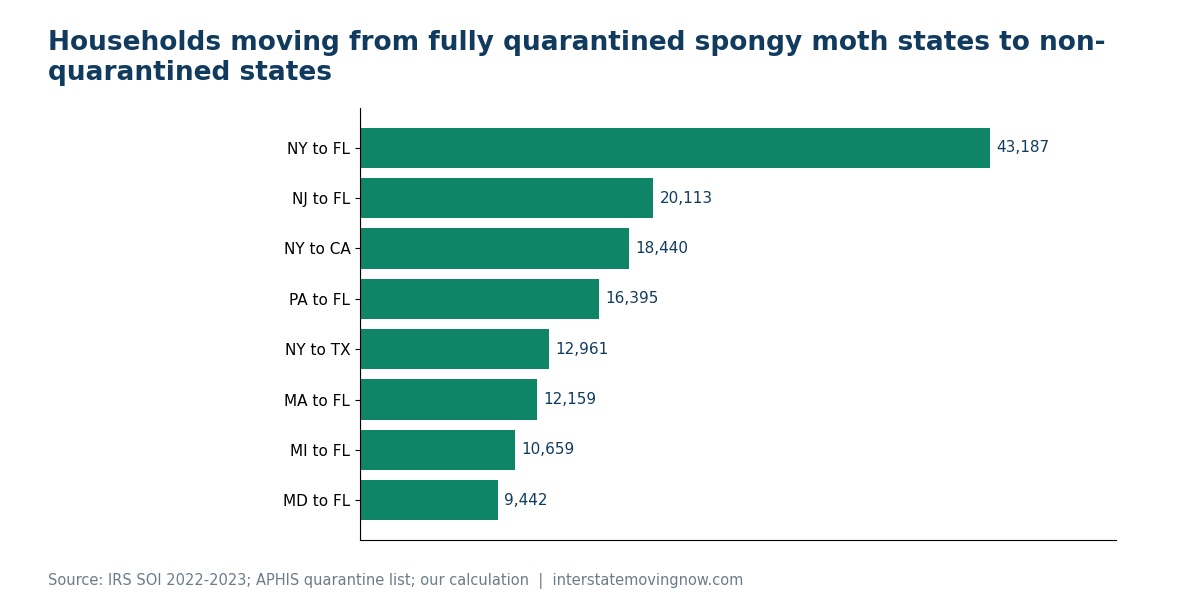
Our analysis: how many moves need a spongy moth inspection?
Using the IRS 2022–2023 state migration data, we counted households moving from the 13 fully quarantined states plus DC to states with no quarantine area at all. The total is about 407,000 households in one year, and the largest routes are all among the busiest in the country:
| Route | Households (2022–2023) |
|---|---|
| New York to Florida | 43,187 |
| New Jersey to Florida | 20,113 |
| New York to California | 18,440 |
| Pennsylvania to Florida | 16,395 |
| New York to Texas | 12,961 |
| Massachusetts to Florida | 12,159 |
| Michigan to Florida | 10,659 |
| Maryland to Florida | 9,442 |
The count excludes moves from partly quarantined states and moves into partly quarantined states, so the true number of households covered is higher. Households without outdoor items have nothing to inspect, but most homes have at least a grill, bikes or patio furniture.
How do you do a spongy moth self-inspection?
Inspect every outdoor item, remove and destroy egg masses, and record it on the checklist. The steps, from the USDA moving flyer:
- Check all surfaces and crevices of outdoor items such as patio furniture, lawn equipment, toys, grills, trailers and vehicles.
- Scrape off egg masses with a putty knife or stiff brush. Drop them in hot, soapy water, or seal them in a plastic bag and leave it in the sun.
- Check each item off on the checklist (PPQ Form 377) and fill in the requested information. You can also hire a qualified certified applicator, who gives you a signed copy.
- Keep a copy of the completed checklist in the vehicle moving the goods. If you are not driving, give a copy to the driver.
- Keep the checklist with your moving records for at least 5 years.
If you move between April and August, inspect on moving day if possible. If you cannot, protect the items from infestation by sealing them under a tarp or keeping them indoors or in a closed truck.
What happens if you skip the inspection?
You and your moving company can face penalties if you were required to inspect and did not, according to the USDA flyer and the APHIS spongy moth page. USDA or state officials may ask for the checklist at any point during the trip. The completed checklist is an official certificate that satisfies the requirements of all non-infested states.
Tell your mover that you have outdoor items from a quarantined area and give the driver a copy of the checklist with the bill of lading. Plants carry their own state rules; see our guide to moving houseplants across state lines.
FAQ
Is the gypsy moth the same as the spongy moth?
Yes. Lymantria dispar was renamed from gypsy moth to spongy moth. Older USDA forms and flyers still use the old name; the rules and checklist are the same.
What items do I need to inspect for spongy moth?
Outdoor household articles: patio furniture, grills, lawn and garden equipment, outdoor toys and play sets, trailers and vehicles, as the USDA flyer lists them. Indoor items packed in boxes are not covered.
Do I need an inspection moving from New York to North Carolina?
Yes, if you move to a part of North Carolina outside the quarantine. Only Currituck County and part of Dare County on the northern coast are quarantined, so most of North Carolina counts as a non-quarantined destination.
Where do I get the checklist?
The self-inspection checklist is USDA APHIS form PPQ 377. It is printed on the back of the USDA moving flyer and available from APHIS and state agriculture departments.
Moving from the Northeast? Compare costs in our New York to Florida cost report.






No Comments