


Quick answer: On an interstate move, a mover must release your belongings once you pay the binding estimate, or up to 110% of a non-binding estimate, plus any services you added and capped extras. Demanding more is “holding goods hostage,” which carries a federal civil penalty of at least $10,000 per violation. Pay the legal maximum, refuse the rest in writing and report it to FMCSA and police.
Hostage goods schemes usually start with a low quote and end with a much higher bill once your belongings are on the truck. Federal law limits what a mover can demand at delivery and punishes those who refuse to unload. The rules below come from 49 CFR 375.703, 49 CFR 375.407 and the penalty statute 49 U.S.C. 14915.
Last updated: November 20, 2026
How much can a mover legally demand at delivery?
The maximum depends on your estimate type. Under 49 CFR 375.703, on a binding estimate the mover can demand the exact estimate; on a non-binding estimate, up to 110% of the estimate. In both cases it can add charges for services you requested after the bill of lading was issued and charges for “impracticable operations” (such as a shuttle or long carry defined in its tariff), but those operations are capped at 15% of all other charges due at delivery.
| Estimate type | Maximum due at delivery | Anything above that |
|---|---|---|
| Binding | Estimate amount + services you added after the bill of lading + impracticable operations (max 15% of other charges) | Billed later, not a condition of delivery |
| Non-binding | 110% of estimate + services you added + impracticable operations (max 15% of other charges) | Billed later, payable within the credit period |
The form of payment is fixed too: the mover must accept the payment method agreed at the estimate unless you agree in writing to change it, under 49 CFR 375.407(a). A demand for cash only, when the estimate said card, is another red flag.
What counts as holding goods hostage?
A mover holds goods hostage when it refuses to deliver after you offer to pay the legal maximum. Under 49 CFR 375.407(b), failing to release a shipment after the shipper offers to pay up to 110% of a non-binding estimate plus the allowed additional charges is a failure to transport with “reasonable dispatch,” which exposes the mover to delay claims. Federal law also makes it a separate violation with its own penalties.
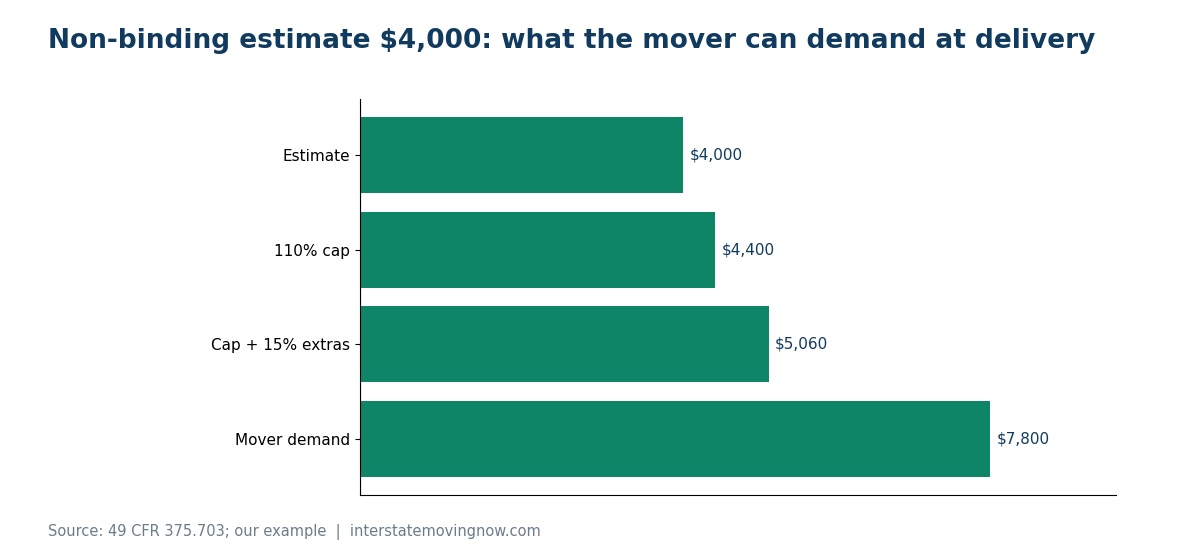
Here is a worked example for a non-binding estimate of $4,000 with no added services:
| Line | Amount |
|---|---|
| Non-binding estimate | $4,000 |
| 110% cap at delivery | $4,400 |
| Impracticable operations, if in the tariff (max 15% of $4,400) | Up to $660 |
| Most the mover can demand to release your goods | $5,060 |
| Mover’s demand | $7,800 |
| Excess the mover cannot require at delivery | $2,740 |
If only part of the shipment arrives, the mover can demand only a prorated share by weight. Under 49 CFR 375.407(c), delivering 2,500 pounds of a 5,000-pound shipment allows a demand of 50% of no more than 110% of the non-binding estimate.
What are the penalties for holding a shipment hostage?
Federal law sets a civil penalty of not less than $10,000 for each violation, and each day a carrier fails to give up the goods may count as a separate violation, under 49 U.S.C. 14915. The government may assign all or part of the penalty to the harmed shipper. If the offender is a carrier or broker, its registration can be suspended for 12 to 36 months, and the suspension extends to companies under the same ownership or control.
These penalties are why documentation matters: the case depends on proving what the estimate said and what you offered to pay.
What should you do if movers hold your belongings hostage?
Offer the legal maximum in writing, keep records and report quickly. The steps:
- Stay calm and record. Note names, the truck number, the USDOT number on the truck and the time. Keep your estimate and bill of lading at hand.
- Offer the legal maximum in writing. Text or email the company: the amount you will pay now under 49 CFR 375.703 and that you dispute the rest.
- Don’t sign blank or new documents that change the price; a mover may not require you to sign a blank document.
- Call local police if the crew refuses to unload after your offer or threatens you.
- Report to FMCSA through the Protect Your Move fraud complaint page and to your state attorney general.
- Pay any disputed balance only under written protest, if you must to recover essential items, and then use arbitration or court to recover it.
Arbitration and court options are covered in our moving arbitration guide.
How can you avoid a hostage goods situation?
Most cases are preventable before moving day. Check the company’s registration and its real name against the FMCSA record, as explained in our guide to checking a USDOT number. Get a written estimate after an in-person or video survey, and prefer a binding or not-to-exceed estimate.
Read the bill of lading before you sign: it must state the maximum amount you must pay at delivery to get your goods, under 49 CFR 375.505. A quote far below others is a warning, as our report on moving complaints and scams shows.
FAQ
Can movers hold my stuff until I pay?
They can require payment of the legal maximum at delivery: the binding estimate, or up to 110% of a non-binding estimate, plus services you added and capped impracticable-operation charges. Refusing to deliver after you offer that amount violates federal rules.
What happens to charges above the 110% limit?
The mover must bill them after delivery. Under 49 CFR 375.807, it must present the invoice within 15 days of delivery (excluding weekends and federal holidays); the 7-day credit period extends automatically to 30 days with a 1% service charge, minimum $20. You can dispute the charges through the mover’s arbitration program.
Does the 110% rule apply to local moves?
No. The 110% rule and the hostage penalty apply to interstate household goods moves. Moves within one state are regulated by that state; contact your state attorney general or transportation department.
Who do I call if movers won’t deliver my belongings?
Call local police if there’s an immediate dispute, then file a complaint with FMCSA through its Protect Your Move pages and with your state attorney general. Keep copies of the estimate, bill of lading and your written payment offer.
Planning a move? Start with our list of questions to ask a moving company.





No Comments