


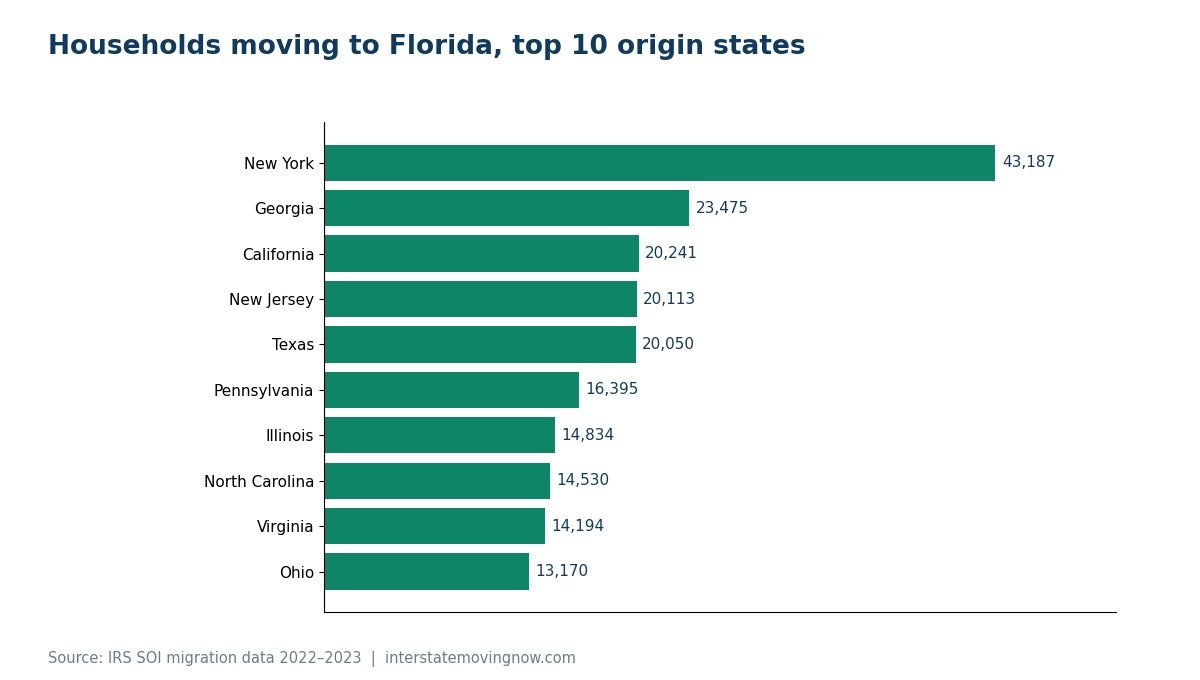
Quick answer: New York sends Florida more new residents than any other state: 43,187 households, or 12.2% of all domestic arrivals, in the latest IRS data. Georgia, California, New Jersey and Texas follow. Florida gains on net from the Northeast, Midwest and California, but loses households to Georgia, Texas, North Carolina and Tennessee.
Florida gained more income from movers than any other state, a net $20.65 billion, according to our income migration by state report. This report looks at where those newcomers come from and where Floridians go when they leave. All figures come from the IRS Statistics of Income state-to-state migration data for 2022–2023, which tracks tax returns whose address changed states between two filing years.
Last updated: October 23, 2026
Key findings
- 354,112 households moved to Florida from other states, bringing $43.39 billion in adjusted gross income.
- New York is the largest source: 43,187 households (12.2% of arrivals) and $5.75 billion in income, twice as many as any other state.
- Florida gained the most on net from New York (+21,176 households), then New Jersey (+11,066) and California (+6,128).
- Florida lost households on net to Georgia (−4,788), Texas (−4,146), North Carolina (−6,023) and Tennessee (−3,030).
- Newcomers from Illinois averaged $223,000 in AGI, and from Massachusetts $209,000, the highest of any large source state.
Where do people moving to Florida come from?
The 15 largest sources of new Florida households in the IRS inflow file, with the reverse flow and the net result for Florida:
| Origin state | Households to Florida | Share of arrivals | Avg AGI, arrivals | Households from Florida to that state | Net for Florida |
|---|---|---|---|---|---|
| New York | 43,187 | 12.2% | $133K | 22,011 | +21,176 |
| Georgia | 23,475 | 6.6% | $91K | 28,263 | −4,788 |
| California | 20,241 | 5.7% | $130K | 14,113 | +6,128 |
| New Jersey | 20,113 | 5.7% | $147K | 9,047 | +11,066 |
| Texas | 20,050 | 5.7% | $92K | 24,196 | −4,146 |
| Pennsylvania | 16,395 | 4.6% | $120K | 11,056 | +5,339 |
| Illinois | 14,834 | 4.2% | $223K | 9,299 | +5,535 |
| North Carolina | 14,530 | 4.1% | $96K | 20,553 | −6,023 |
| Virginia | 14,194 | 4.0% | $119K | 12,414 | +1,780 |
| Ohio | 13,170 | 3.7% | $120K | 10,564 | +2,606 |
| Massachusetts | 12,159 | 3.4% | $209K | 8,058 | +4,101 |
| Michigan | 10,659 | 3.0% | $119K | 8,263 | +2,396 |
| Tennessee | 9,475 | 2.7% | $86K | 12,505 | −3,030 |
| Maryland | 9,442 | 2.7% | $140K | 5,941 | +3,501 |
| Colorado | 9,070 | 2.6% | $105K | 8,639 | +431 |
Where do Floridians move when they leave?
Florida’s outflow runs mostly to its Sun Belt neighbors. More Florida households moved to Georgia (28,263), Texas (24,196), New York (22,011), North Carolina (20,553) and California (14,113) than to any other states, with Tennessee (12,505) next. Florida loses households on net to Georgia, Texas, North Carolina and Tennessee, and the reasons look financial: households leaving Florida for those four states reported lower average income than the people arriving from them. Floridians moving to Georgia averaged $65,000 in AGI, compared with $91,000 for Georgians moving to Florida. Costs on the busiest exit route are in our Florida to Georgia report, and the Texas route in our Florida to Texas report.
Living costs help explain it. In the data we compiled this year, Florida has the highest average homeowners insurance premium in the country ($2,677) in our home insurance by state report, and Miami’s typical rent ($2,654) is well above Atlanta’s ($1,843) in our rent report.
Our analysis: Florida attracts income, its neighbors attract households
We split the 15 largest exchanges into two groups. With the Northeast, Midwest, Mid-Atlantic and California, Florida wins on both counts: more households arrive than leave, and arrivals report higher income, from $105,000 (Colorado) to $223,000 (Illinois). With Georgia, Texas, North Carolina and Tennessee, Florida loses households on net, but those exchanges are with states that also gain migrants overall, and the households Florida receives from them still out-earn the ones it sends.
| Group | States | Net households for Florida | Avg AGI of arrivals |
|---|---|---|---|
| High-cost origins | NY, NJ, CA, PA, IL, MA, MD, VA, OH, MI, CO | +64,059 | $105K – $223K |
| Sun Belt neighbors | GA, TX, NC, TN | −17,987 | $86K – $96K |
For movers, that split predicts the market. Routes from the Northeast and Midwest into Florida are among the busiest and highest-value long-distance routes in the country, so book early in spring and summer. Routes out of Florida to Georgia, the Carolinas and Texas are shorter and cheaper. Our New York to Florida, New Jersey to Florida and California to Florida reports show what each costs.
Which states send Florida its highest-earning newcomers?
Ranked by average AGI per household among states sending at least 2,000 households, the IRS inflow data shows a clear Northern tilt:
| Origin state | Households to Florida | Total AGI | Avg AGI per household |
|---|---|---|---|
| Illinois | 14,834 | $3.31B | $223K |
| Massachusetts | 12,159 | $2.54B | $209K |
| Minnesota | 4,951 | $0.86B | $174K |
| Connecticut | 7,668 | $1.21B | $158K |
| New Hampshire | 2,696 | $0.42B | $155K |
| New Jersey | 20,113 | $2.96B | $147K |
These averages are pulled up by a small number of very high earners, so the typical household from each state earns less than the average suggests. Even so, Illinois sends Florida about a third as many households as New York but more than half as much income. Five of the six are states with an income tax, the exception being New Hampshire, which doesn’t tax wages; the Tax Foundation confirms Florida has no individual income tax at all.
Is migration to Florida slowing down?
Yes. Florida’s net income gain from domestic movers fell from $35.99 billion in the IRS 2021–2022 data to $20.65 billion in 2022–2023, and its net gain in households fell from 125,551 to 55,349. Florida is still the country’s biggest income winner by far, but the pandemic-era surge has cooled. Higher home prices, insurance costs and mortgage rates are the likely brakes, as our mortgage rate lock-in report describes.
Methodology and sources
All migration figures come from the IRS SOI state-to-state migration files for 2022–2023 (stateinflow2223 and stateoutflow2223), with the 2021–2022 files for the trend comparison. A household is one tax return; AGI is adjusted gross income in thousands of dollars on the returns. Shares, net figures and averages are our calculations; the group totals sum the net figures for the states listed. The data only covers people who filed returns in both years, so it undercounts low-income retirees, students and non-filers, and it lags by about three years. Insurance and rent comparisons are from our other 2026 reports, which cite NAIC and Zillow data.
FAQ
Which state do most people moving to Florida come from?
New York. In the latest IRS data, 43,187 households moved from New York to Florida, 12.2% of all domestic arrivals and about twice as many as from Georgia, the next largest source.
How many people move to Florida each year?
About 354,000 households, roughly 600,000 people, moved to Florida from other states between the 2022 and 2023 filing years, according to IRS data. Florida’s net gain after departures was 55,349 households.
Where are people leaving Florida moving to?
Mostly to Georgia, Texas, New York, North Carolina and California. Florida loses households on net to Georgia, Texas, North Carolina and Tennessee, but gains on net from New York.
Are rich people moving to Florida?
Higher earners are overrepresented. Households moving to Florida averaged $123,000 in AGI, against $76,000 for those leaving, and arrivals from Illinois and Massachusetts averaged over $200,000.







No Comments