


Quick answer: Residential electricity costs 12.72 cents per kWh in Nevada and 47.18 cents in Hawaii, against a U.S. average of 18.16 cents in August 2026. On the busiest moving routes, the difference is large: at the same usage, a household moving from California to Texas pays about $124 less per month for power, or roughly $1,490 a year.
Utility bills are one of the costs people forget to compare before an interstate move. This report uses the U.S. Energy Information Administration’s Electric Power Monthly, Table 5.6.A, which reports the average retail price of electricity by state and sector, and EIA’s figure for average household electricity use. We combined the two to estimate a monthly bill in every state and on the country’s largest migration corridors.
Last updated: October 23, 2026
Key findings
- The U.S. average residential price was 18.16 cents per kWh in August 2026, up from 17.57 cents a year earlier, about 3.4%.
- Nevada (12.72¢), Louisiana (12.87¢), North Dakota and Utah (13.31¢) had the cheapest residential power; Hawaii (47.18¢), Maine (32.11¢) and Massachusetts (30.48¢) the most expensive.
- All ten states that gained the most households in the latest IRS migration data price residential power below the national average; Nevada, Tennessee and Washington are among the cheapest.
- California to Nevada saves the most of the top income corridors: about $153 a month at average usage.
- Florida to Georgia is the exception: power costs slightly more in Georgia, about $8 a month.
Which states have the cheapest and most expensive electricity?
Prices below are average residential retail prices for August 2026 from EIA Table 5.6.A. August is a peak-demand summer month; 2026 figures are preliminary. The estimated bill uses EIA’s national average of 899 kWh per month.
| Cheapest states | ¢/kWh | Est. bill at 899 kWh | Most expensive states | ¢/kWh | Est. bill at 899 kWh |
|---|---|---|---|---|---|
| Nevada | 12.72 | $114 | Hawaii | 47.18 | $424 |
| Louisiana | 12.87 | $116 | Maine | 32.11 | $289 |
| North Dakota | 13.31 | $120 | Massachusetts | 30.48 | $274 |
| Utah | 13.31 | $120 | California | 29.75 | $267 |
| Idaho | 13.37 | $120 | Alaska | 29.41 | $264 |
| Tennessee | 13.42 | $121 | New York | 28.65 | $258 |
| Nebraska | 13.54 | $122 | Rhode Island | 28.18 | $253 |
| Kentucky | 13.80 | $124 | New Hampshire | 27.64 | $248 |
The pattern is regional. New England, New York, California, Alaska and Hawaii pay the most; the Mountain West, Plains and parts of the South pay the least. Most of the states people are leaving, according to our states people are leaving report, sit in the expensive group.
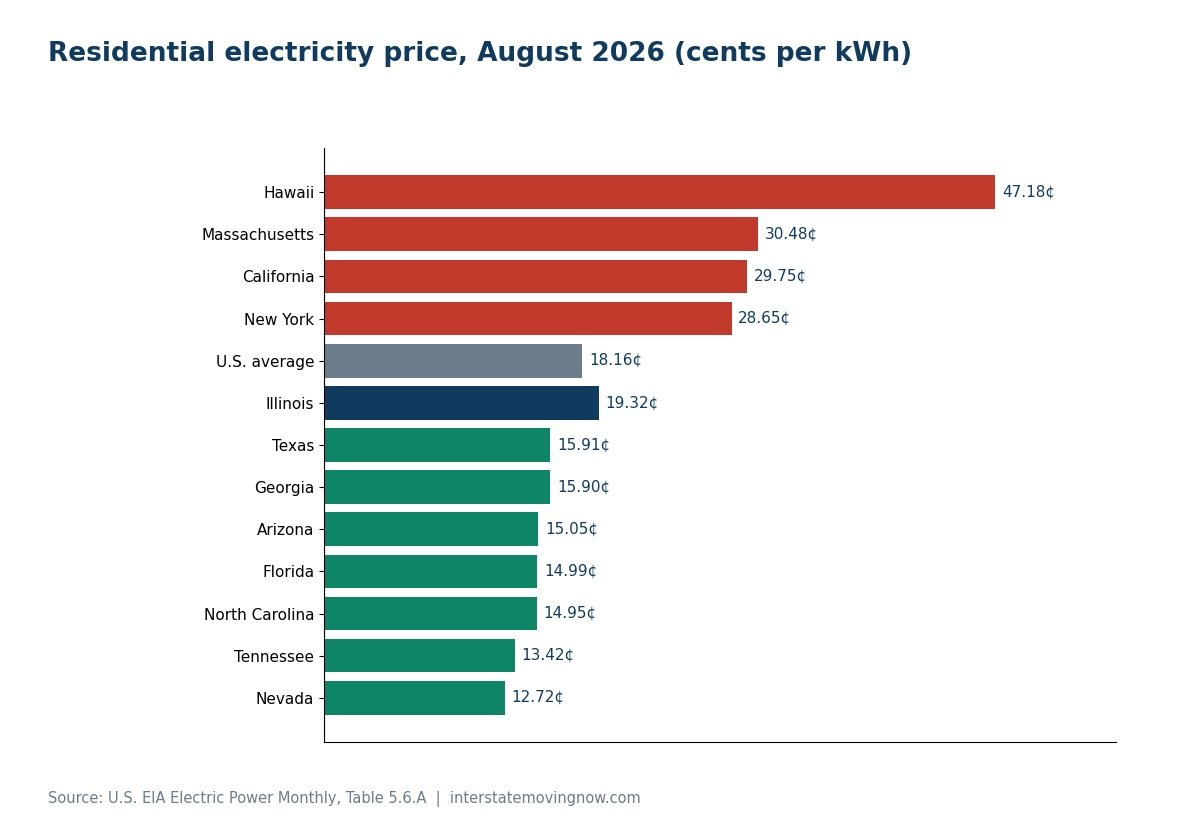
How much do movers save on electricity on the busiest routes?
Our analysis: we took the ten largest state-to-state income corridors from IRS migration data, plus two popular shorter routes, and compared EIA’s August 2026 price at each end, at the same 899 kWh a month.
| Route | Origin ¢/kWh | Destination ¢/kWh | Monthly difference | Yearly difference |
|---|---|---|---|---|
| California → Nevada | 29.75 | 12.72 | −$153 | −$1,837 |
| Massachusetts → Florida | 30.48 | 14.99 | −$139 | −$1,671 |
| California → Washington | 29.75 | 14.63 | −$136 | −$1,631 |
| California → Florida | 29.75 | 14.99 | −$133 | −$1,592 |
| California → Arizona | 29.75 | 15.05 | −$132 | −$1,586 |
| California → Texas | 29.75 | 15.91 | −$124 | −$1,493 |
| New York → North Carolina | 28.65 | 14.95 | −$123 | −$1,478 |
| New York → Florida | 28.65 | 14.99 | −$123 | −$1,474 |
| New Jersey → Florida | 24.61 | 14.99 | −$86 | −$1,038 |
| Illinois → Florida | 19.32 | 14.99 | −$39 | −$467 |
| Illinois → Texas | 19.32 | 15.91 | −$31 | −$368 |
| Florida → Georgia | 14.99 | 15.90 | +$8 | +$98 |
The catch is usage. Southern homes run air conditioning for more of the year, and EIA notes that Louisiana households buy the most electricity per customer (14,774 kWh a year in 2022) while Hawaii households buy the least (6,178 kWh). A Texas or Florida home can use far more than 899 kWh in summer, so the real saving is usually smaller than the price gap suggests. Treat the table as a price comparison, not a bill forecast.
Where are electricity prices rising fastest?
Comparing August 2026 with August 2025 in the same EIA table, residential prices rose most in Hawaii (+22.5%), Maine (+14.1%), New Hampshire (+13.1%), the District of Columbia (+12.1%), Virginia (+11.3%), Delaware (+11.0%), Michigan (+10.9%) and Idaho (+10.7%). Prices fell in Connecticut (−18.8%), California (−3.8%), Utah (−2.3%) and Florida (−2.2%).
Idaho is worth watching for movers: it is still among the cheapest states at 13.37 cents, but its price rose more than 10% in a year. One month is a noisy comparison, so check your utility’s current residential rate schedule before relying on any single figure.
What else should you budget for utilities after a move?
Electricity is only one line. When you set up service in a new state, expect:
- Deposits: many utilities ask new customers without local credit history for a deposit; a letter of good payment history from your old utility can sometimes waive it.
- Connection fees for electric, gas and water service.
- Different rate plans: Texas has a competitive retail electricity market where you choose a provider; most states assign one utility by address.
- Seasonal swings: a summer bill in Arizona or Florida and a winter heating bill in the Northeast can be double the annual average.
For the bigger picture of what changes when you relocate, see our cost of living by state report and the address change checklist.
Methodology and sources
Prices are average residential retail electricity prices in cents per kWh from EIA Electric Power Monthly Table 5.6.A, August 2026 (preliminary) and August 2025, retrieved October 23, 2026. Average residential use of 899 kWh per month is EIA’s 2022 national figure. Estimated bills are price × 899 kWh, excluding fixed customer charges and taxes. Corridors come from the IRS SOI 2022–2023 state-to-state migration data. All differences are our calculations. Limitations: state averages hide large differences between utilities in the same state, and one summer month does not represent a full year.
FAQ
Which state has the cheapest electricity?
Nevada, at 12.72 cents per kWh for residential customers in August 2026, followed by Louisiana at 12.87 cents, according to EIA data.
Which state has the most expensive electricity?
Hawaii, at 47.18 cents per kWh in August 2026, more than 2.5 times the U.S. average of 18.16 cents. Maine and Massachusetts follow.
Is electricity cheaper in Texas than in California?
Yes. Texas residential power averaged 15.91 cents per kWh in August 2026 against 29.75 cents in California, about $124 less per month at average usage. Texas homes often use more power for cooling, which narrows the gap.
How much electricity does an average home use?
About 899 kWh per month, or 10,791 kWh a year, for the average U.S. residential customer in 2022, according to EIA. Use ranges from about 6,200 kWh a year in Hawaii to 14,800 in Louisiana.
Budget the move itself with our interstate moving cost calculator.








No Comments