


Quick answer: Californians are by far the largest group moving to Texas: 44,417 California households (82,481 people) moved there in the latest IRS data, nearly twice as many as from Florida, the second-largest source. Texas gained a net 56,473 households and $5.54 billion in income from other states in 2022–2023, while losing residents to Colorado, Oklahoma and North Carolina.
Texas gained more households from other states than any other state in the latest IRS data, just ahead of Florida (55,349), though Florida gained far more income. The flows are less one-sided than the “everyone is moving to Texas” story suggests. The figures below come from the IRS Statistics of Income state-to-state migration data, which tracks the addresses on federal tax returns filed in 2022 and 2023. Each return is roughly one household; the data also counts the people on those returns and their adjusted gross income (AGI).
Last updated: November 20, 2026
Key findings
- Net gain of 56,473 households and 112,481 people from other states, carrying $5.54 billion more in AGI than Texans who left.
- California supplies 14% of all domestic arrivals: 44,417 of 307,240 households moving to Texas came from California.
- Californians arriving in Texas reported $107,273 in average AGI, about $24,000 above the average of all arrivals ($83,632).
- Texas loses on three routes: more households left for Colorado (−2,648 net), Oklahoma (−1,425) and North Carolina (−307) than came from them.
- The Florida swap is uneven: Floridians moving to Texas averaged $70,034 in AGI, while Texans moving to Florida averaged $91,708.
How many people move to Texas each year?
About 307,240 households with 553,369 people moved to Texas from other states in the 2022–2023 IRS migration data, reporting $25.70 billion in adjusted gross income. In the same period, 250,767 households with 440,888 people left Texas for other states, taking $20.15 billion. The difference is Texas’s net gain from domestic migration: 56,473 households, 112,481 people and $5.54 billion in income.
| Direction | Households (returns) | People | Total AGI | Average AGI per household |
|---|---|---|---|---|
| Moved to Texas from other states | 307,240 | 553,369 | $25.70 billion | $83,632 |
| Left Texas for other states | 250,767 | 440,888 | $20.15 billion | $80,359 |
| Net gain for Texas | +56,473 | +112,481 | +$5.54 billion | +$3,273 |
Arrivals earn only slightly more on average than leavers, about $3,300 a year. That is a much smaller income gap than Florida’s, which our income migration by state report puts at roughly $46,000 per household.
Where do people moving to Texas come from?
California, Florida and Louisiana are the three largest sources of new Texas households. The IRS data shows 44,417 households arriving from California, 24,196 from Florida and 15,068 from neighboring Louisiana. New York, Colorado and Illinois each sent more than 12,000.
| Origin state | Households to Texas | People | Average AGI | Households Texas sent back | Net for Texas |
|---|---|---|---|---|---|
| California | 44,417 | 82,481 | $107,273 | 24,970 | +19,447 |
| Florida | 24,196 | 41,655 | $70,034 | 20,050 | +4,146 |
| Louisiana | 15,068 | 27,449 | $56,976 | 10,522 | +4,546 |
| New York | 12,961 | 21,697 | $89,975 | 9,433 | +3,528 |
| Colorado | 12,275 | 21,783 | $88,673 | 14,923 | −2,648 |
| Illinois | 12,078 | 21,406 | $103,260 | 8,236 | +3,842 |
| Georgia | 10,897 | 19,575 | $68,672 | 9,120 | +1,777 |
| Oklahoma | 10,157 | 18,390 | $65,713 | 11,582 | −1,425 |
| Arizona | 9,966 | 17,750 | $80,303 | 8,463 | +1,503 |
| Washington | 9,863 | 19,119 | $119,401 | 9,307 | +556 |
Washington State movers report the highest average income of any large source, $119,401, slightly above Californians. Households from neighboring Louisiana report the lowest average, $56,976.
Are Californians really moving to Texas?
Yes. California is the single largest source of new Texas residents, and the flow runs nearly two to one. In the 2022–2023 IRS figures, 44,417 California households moved to Texas and 24,970 Texas households moved to California, a net gain of 19,447 households for Texas. That one route accounts for about a third of Texas’s entire net gain from other states.
Income moves with them: California households arriving in Texas reported $4.76 billion in AGI, against $2.38 billion for Texans heading to California. Housing explains much of the pull. The typical California home was worth $760,612 in October 2026 against $294,311 in Texas, according to Zillow. Our California to Texas moving cost report covers the price of the move itself.
Which states are Texans moving to?
Texans leaving the state most often go to California, Florida, Colorado and Oklahoma. The IRS data counts 24,970 Texas households moving to California, 20,050 to Florida, 14,923 to Colorado and 11,582 to Oklahoma. Colorado and Oklahoma stand out because Texas loses more households to them than it gains.
The Florida route shows a different pattern on income. Texans moving to Florida reported an average AGI of $91,708, while Floridians moving to Texas averaged $70,034. Florida draws higher-earning and retired Texans; Texas draws Florida workers. North Carolina is close to even, with 8,694 Texas households moving there and 8,387 coming the other way.
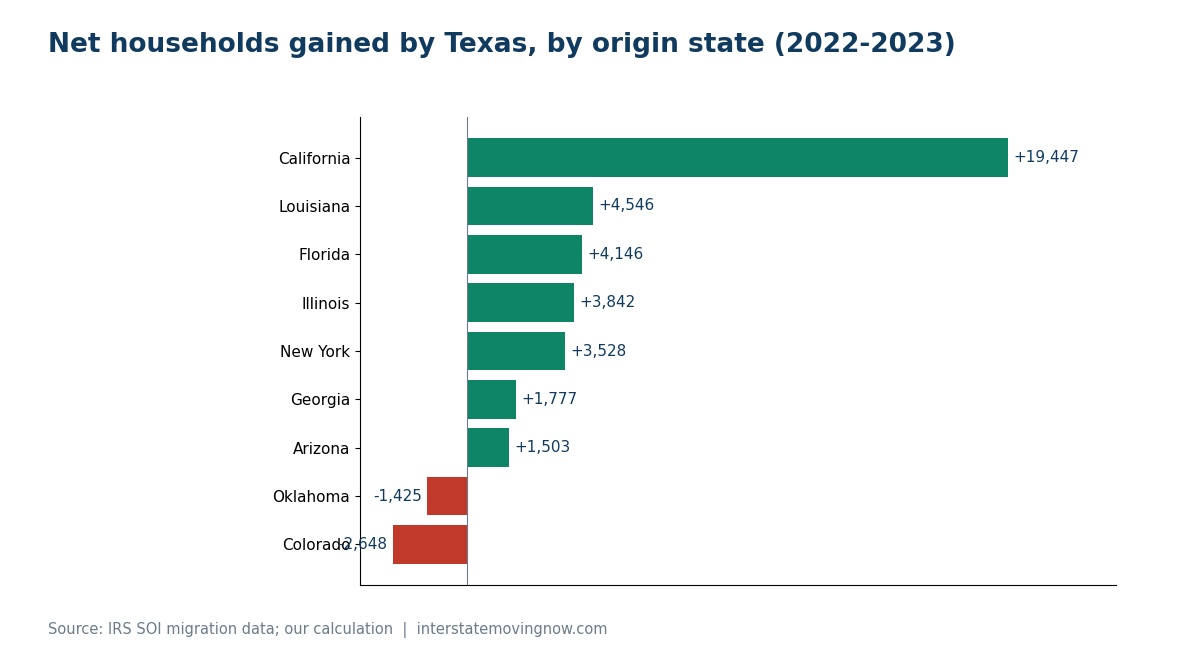
Our analysis: Texas’s net gain by origin state
We netted arrivals against departures for every state pair in the IRS file. Five states account for most of Texas’s domestic population gain:
| Origin state | Net households gained by Texas | Share of Texas’s net gain (56,473) |
|---|---|---|
| California | +19,447 | 34% |
| Louisiana | +4,546 | 8% |
| Florida | +4,146 | 7% |
| Illinois | +3,842 | 7% |
| New York | +3,528 | 6% |
| Colorado | −2,648 | −5% |
| Oklahoma | −1,425 | −3% |
Without California, Texas’s net gain from other states would fall by about a third. The data also shows Texas exporting households to cooler, cheaper or mountain states, so movers weighing Texas against Colorado are choosing between two markets that trade residents in both directions.
Methodology and sources
All migration figures are from the IRS Statistics of Income state-to-state inflow and outflow files for 2022–2023 (returns filed in 2022 compared with returns filed in 2023). “Households” means tax returns; “people” means the number of exemptions or individuals on those returns; AGI is in current dollars. The data covers only people who file federal tax returns in both years, so it undercounts some retirees with low income, students and new arrivals from abroad. Average AGI is total AGI divided by returns. Net figures and shares are our calculations from the same files. Home values are the Zillow Home Value Index for October 2026.
FAQ
How many Californians moved to Texas?
The IRS counted 44,417 California households, covering 82,481 people, moving to Texas between the 2022 and 2023 tax filings. They reported $4.76 billion in adjusted gross income. Over the same period 24,970 Texas households moved to California.
Is Texas losing people to other states?
Texas gains on balance, a net 56,473 households in 2022–2023, but it loses more residents than it gains on a few routes. Colorado took 2,648 more Texas households than it sent, Oklahoma 1,425 more and North Carolina 307 more.
Do people moving to Texas earn more than Texans who leave?
Slightly. Households arriving in Texas averaged $83,632 in AGI against $80,359 for those leaving. The gap is much bigger on single routes: Californians arriving averaged $107,273, while Floridians arriving averaged $70,034.
What does a move to Texas cost?
It depends on the origin and home size. Our corridor reports cover the main routes: California to Texas, Florida to Texas and Illinois to Texas.
Planning a move to Texas? Get a price range for your route with our interstate moving cost calculator.








No Comments